Attack paths
The audit lists weaknesses one by one. An attacker chains them. Analysis > Attack paths (Ctrl+Shift+K) answers the question that matters: who can take control of the domain, and through which steps?
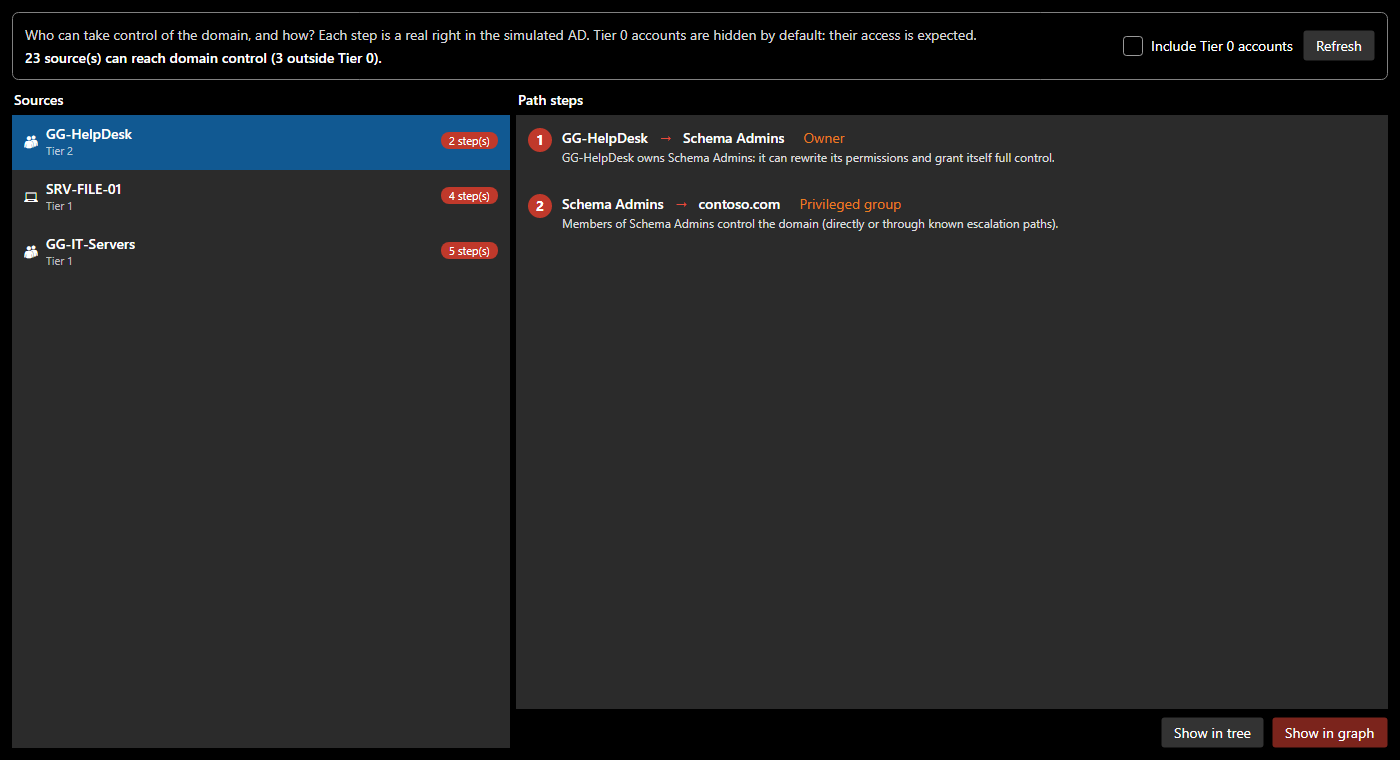
Screenshot: the sample domain, with a weakness added for this documentation. The help desk is still the owner of the Schema Admins group.
Reading the window
- Sources, on the left: every account, group or machine that can reach domain control, with its number of steps. Any domain user stands for an attacker with nothing but an ordinary account: a path from this source is the most severe, and it comes first.
- Steps, on the right: the shortest path, each step with its technique and explanation.
- Include Tier 0 accounts: these accounts control the domain by definition, so they are hidden by default. What remains is what needs fixing.
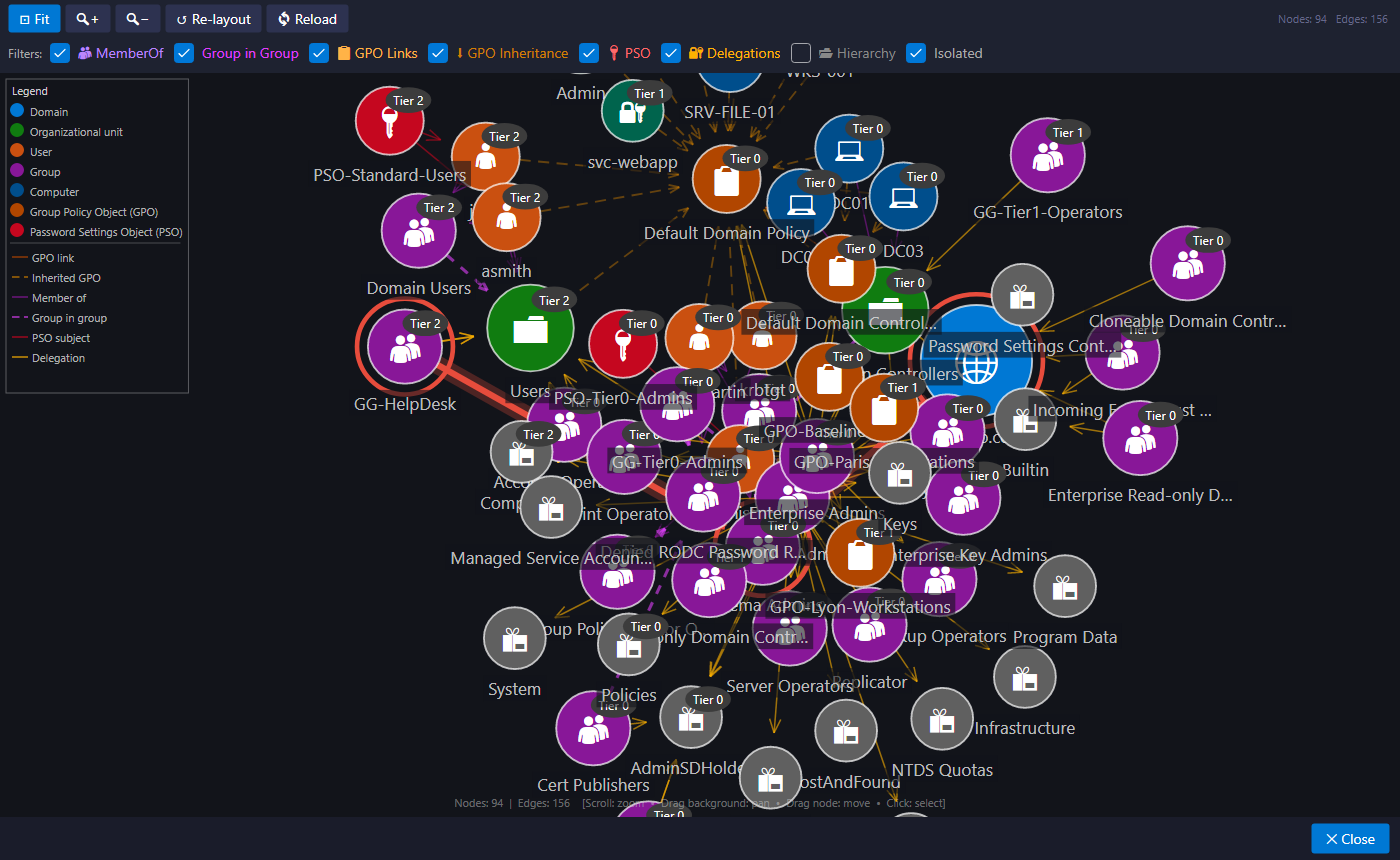
- Show in tree selects the step's object; Show in graph highlights the whole path.
How the attack graph is built
SMAD-X builds an "X can take control of Y" graph, like a much simpler BloodHound, then looks for the shortest path to the domain with a breadth-first search.
| Technique | Edge | Why |
|---|---|---|
| Member of | account or group → group | the member inherits the group's rights |
| Privileged group | group → domain | Domain Admins, Enterprise Admins, Administrators, Schema Admins, Account / Server / Backup / Print Operators, DnsAdmins, Key Admins, Enterprise Key Admins, Domain Controllers |
| Domain controller | DC → domain | compromising a DC compromises the domain (DCSync, NTDS.dit) |
| Owner | owner → object | an owner can always rewrite permissions |
| Full control | trustee → OU and its objects | GenericAll delegation |
| Write all attributes | trustee → object and what it contains | GenericWrite: SPN, msDS-KeyCredentialLink, members, delegation |
| Modify permissions, Change owner | trustee → object | WriteDacl, WriteOwner: full control is then one step away |
| Password reset | trustee → users of the OU | changing the password is enough; all extended rights allow it too |
| Group membership change | trustee → groups of the OU | right to write the member attribute |
| DCSync | trustee → domain | replication rights on the domain root (or all extended rights): the secrets of every account |
| Shadow Credentials | trustee → users and computers | write msDS-KeyCredentialLink, add one's key and authenticate as the account |
| Resource-based constrained delegation (RBCD) | trustee → computers | write msDS-AllowedToActOnBehalfOfOtherIdentity: a ticket to the machine in anyone's name |
| Targeted Kerberoasting | trustee → users | add an SPN to the account, then crack its password offline |
| Read the LAPS password | trustee → computers managed by LAPS | the local administrator password |
| Read the gMSA password | trustee → group managed service account | the account's password, hence its rights |
| Local administrator | account or group → computer | controls the machine and what sits in its memory |
| Open session | computer → account | an administrator of the machine steals the credentials of the logged-on account |
| Linked GPO | GPO → accounts of the OU | whoever controls the GPO runs code on them |
| GPO link, GPO linked to the OU | trustee → OU → its accounts | whoever controls an OU (or can write gPLink) links a GPO there, which reaches even protected accounts |
| Container contents | container → its accounts and groups | whoever controls the container grants itself a right inherited by what it contains |
| AdminSDHolder | AdminSDHolder → protected accounts and groups | SDProp copies its permissions onto them every hour |
| Kerberoasting | any user → account with an SPN | ticket encrypted with the password, cracked offline |
| AS-REP roasting | any user → account without preauthentication | response encrypted with the password |
| Empty password | any user → PASSWD_NOTREQD account | an empty password may be accepted |
| Unconstrained delegation | server → domain | a DC coerced into authenticating leaves its TGT there |
| Constrained delegation to a DC | account → DC | impersonating an administrator to a DC service |
Delegations granted to Domain Users, Authenticated Users or Everyone start from "any domain user". A disabled account is not an entry point.
What AdminSDHolder prevents
A delegation set on an OU does not apply to protected objects (adminCount = 1): SDProp disabled their inheritance. A trustee who can reset passwords in an OU therefore cannot reset the password of a Domain Admins member stored in that OU. But whoever controls the OU can link a GPO to it, which also reaches protected accounts; and whoever controls AdminSDHolder controls every protected object. Not every sensitive group is protected, though: check the list of protected groups for your Windows Server version. Domain controllers are not protected either: a delegation set on the domain root or on the Domain Controllers OU reaches them.
Local administrators and sessions are not in the directory: a joined computer has Domain Admins as local administrator, and sessions are set by hand (the computer's Security section, see Modeling), to show where an administrator logs on.
Practise
The labs of the "Attack paths" series offer fifteen realistic situations, in English and French, to solve with this window. Their solutions are not published: finding the path and the right fix is up to you.